
One of the most common questions I get on my Instagram is “I wanna be a flight nurse but don’t know where to start! What do you recommend?”
Well let me start by saying– there is no one clearcut path and the path is a different one from state-to-state. But don’t let this deter you from continuing to read!
If you read my “About the Blogger” page–you’ll see that my own path was a winding, treacherous one with little guidance but my own dreams and aspirations. That is step one–set your goal. So already you’re own your way to joining the flight community by simply identifying your own dreams.
“Ok Steph…great…super helpful…” I hear you cry.
But quite honestly, it is the truth. I wouldn’t have gotten here without understanding my passion and keeping that end goal firmly in sight. The way is not easy–as it shouldn’t be. You’ll need that dream to motivate you through the journey.
So to start– flight nursing is generally guided by standards set by our regulating/certifying body “the Commission on Accreditation of Medical Transport Systems” or CAMTS (pronounced “cames”). This body accredits critical care transports to ensure patient safety and high-level patient care. It is an umbrella organization that really actually has representatives from a multitude of different organizations such as the Air and Surface Transport Nurses Association, the American College of Surgeons, the National Association of EMS Physicians, the International Association of Flight & Critical Care Paramedics, and the American Association of Critical Care Nurses (plus more not listed). While accreditation by CAMTS is strictly voluntary, many governmental regulating agencies require participation (with good reason!)
As a participant of CAMTS, many helicopter emergency medical services (HEMS) agencies require their crews to maintain competencies in a myriad of different subjects, advanced certification, and a minimal amount of years of experience.
You Can’t Just Jump Right In
“But why?! I always wanted to be a flight nurse/paramedic–can’t I just graduate school and start right away in the field?”
Consider the role of the flight nurse/paramedic–you and one other person are responsible for the life of the sickest or most injured people. You operate based on past experience and your own knowledge base in a small, confined space of an ambulance or helicopter without the oversight of a physician at your immediate disposal. You operate relatively autonomously (based on set protocol sets for your organization) and lack the resources normally found in a hospital.
One such call reminded me of this fact– after retrieving a newly intubated patient who was a difficult one to ventilate, required a great deal of sedation, and simply put was a hot-mess express of a human, our helicopter threw warning lights. We had to be transported with this patient from the confines of the referring hospital to an air field at a remote site, in the pitch black of night, with this patient. And when our helicopter threw warning lights, we were grounded and couldn’t launch. Meanwhile, we were running out of meds to keep this patient sedated, his fever broke causing him to sweat out his one IV site access, we had no lights but our flashlights, and just the two of us in a small space (pretty sure we were stepping all over each other). I was blessed to have a partner with experience as we attempted to secure more IV access, keep him sedated and titrated his ventilator settings while we awaited another helicopter to retrieve us. Then came the circus of transferring our gear and the patient through a muddy field (still pitch black) into a running helicopter (while keeping the patient under sedation/ventilated) AND making sure one of the lovely first responders who stayed with us didn’t wander into the spinning tail rotor blades of death.
It made me miss the bright lights, multiple staff members, and roominess of my ER rooms (never will I whine about the lack of space in them again!) Because in those situations, you don’t have all that to back you up–hence why you NEED to be competent and experienced.
Respiratory therapy? Thats me. Decision-maker during a code? Thats me. You don’t have your ancillary services readily available. Your physician is miles and miles away via radio–you are their hands, their ears, and their eyes.
What Should I Expect to Get to Qualify?
Still interested? Of course you are! Because in addition to operating at the highest level of your license…well to put it bluntly–this job is freaking cool!!
So what does it take to be a flight nurse? It varies from flight service to flight service but you should expect these (at least):
- 3-5 years of critical care experience (ICU or ED)
- Basic Life Support (BLS)
- Advanced Life Support (ACLS)
- Pediatric Advanced Life Support (PALS)
- Neonatal Resuscitation Program (NRP)
- Trauma Certification (ITLS, PHTLS, ATCN)
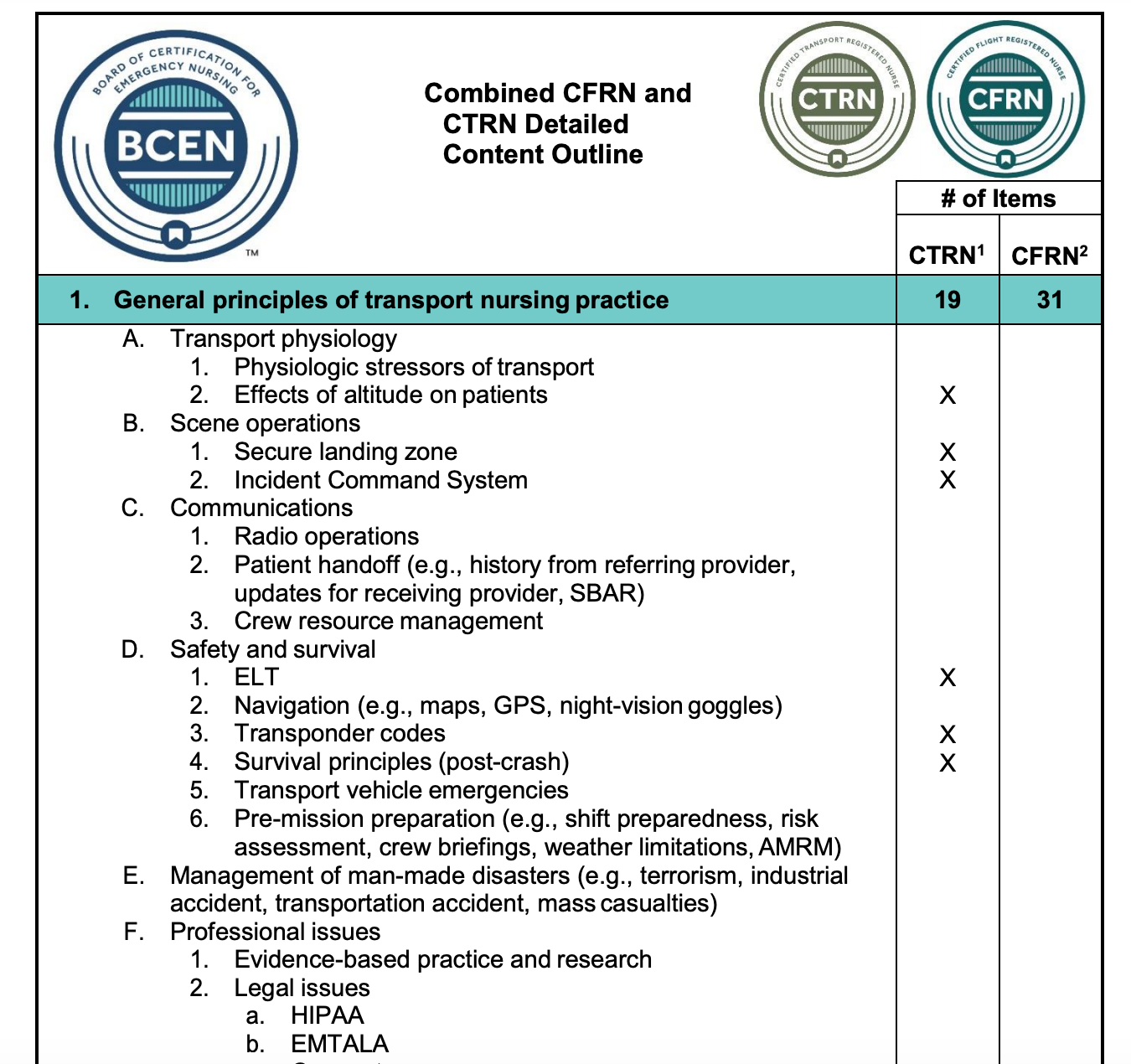
- Advanced Certification (CCRN, CEN, or CFRN, etc)
- Prehospital licensure (varies state to state, contact your state’s EMS regulatory agency for more information on this– Pennsylvania requires non-EMT RN’s to take a “Pre-hospital Registered Nurse (PHRN)” program prior to testing or if an EMT already, the RN to challenge the “National Registry Paramedic Cognitive” exam)
Many of you already out and working, probably have some of these or can get them through your hospital. Others (like me) have to go out and find these.
It Came at a Cost, Though
One secret I’m going to tell you though: it was expensive for me to get qualified. While I had BLS, ACLS, and PALs as job requirements for the ED… I had to go out and find the rest.
Being an EMT, I challenged the paramedic cognitive–this cost me about 200$ whereas had I gone through the PHRN prep program at a local community-college, it would’ve cost me $1,500 and 7-8 months of class time. (More on this later)
Neonatal Resuscitation Program cost me about 75$ even though it was offered through my hospital. Depending on where you take this, it can go upwards of 100-200$.
Advanced Trauma Care in Nursing (ATCN) cost me another 250-275$ (add on the additional almost 300$ I paid to become an instructor after being identified as an “instructor candidate”–unless you get chosen for this and wish to obtain it, don’t worry about this added cost.)
In addition, I bulked up my resume with Advanced Burn Life Support (ABLS), Tactical Combat Casualty Care (TCCC), Advanced Stroke Life Support (ASLS), and other trauma courses above and beyond what the minimums were.
Flight programs also lean heavily on bachelors of science in nursing degrees–you either need to already have it, be working on it, or obtain it within a certain amount of years.
So What Did I Do and What Do I Recommend?
Another question I frequently get is “should I do this or that?”
Let me start with my journey and what worked or didn’t work for me before I give my recommendations.
As I noted in my “About the Blogger” page of my blog– I started in BLS EMS back in 2007. Finished my BSN in 2014 and entered into a community Adult ICU. This ICU had its share of ventilators and drips but generally speaking, anything of high acuity was shipped out to the larger tertiary care center not far away. I was frequently assigned between the ICU and stepdown unit (stepdown more often than ICU) or floated to the medical/surgical floors to work as an aide. I quickly tired of this and sought after a position in a busy emergency department closer to home.
I worked in the ED for four years before getting interviews for flight services. I often gravitated more towards the critical/trauma bays and found myself super frustrated with the urgent care level patients–I craved the ability to use my critical thinking and to handle the sickest patients.
April 2016, I obtained my Trauma Certified Registered Nurse certification from the Board of Certification of Emergency Nurses and March 2018, I obtained my Certified Emergency Nurse certification.
I challenged the paramedic cognitive after self-studying and passed.
I entertained two offers for flight services and accepted one closer to home and began my orientation in October 2018.
What I quickly realized in my orientation: I’m not the hot shot I thought!
While I saved money and felt I was ready to undertake the PHRN role–I found that not taking the PHRN prep class put me behind. I had to learn all the State ALS/Critical Care protocols in addition to my service’s protocols. I had no experience in airway management beyond manakins and theory whereas my colleagues who prep-classed had clinical time through their programs.
Recommendation: regardless of your experience, take the prep class and take it seriously.
Further, while the emergency department gave me broad experience with all ages (womb to tomb if you will), I lacked a great deal of critical care experience that my ICU-level colleagues possessed. I did have more experience with initial stabilization and emergency care which serves me well on scene-calls but when a majority of your transports are interfacility, ICU-level patients, you feel this lack of experience.
Recommendation: If you wish to pursue a career in the ED–great! But be prepared for a steep learning curve. Take advantage of having all age groups. However, I strongly recommend time in a major ICU in neuro or cardiac specialities. This gives you a better jump off point for you to pull experiences from. If you can swing it in your life–DO BOTH! ICUs generally specialize in certain ages, so you don’t get the experience of neonatal or pediatric in the adult ICU and vice versa. In hindsight, I wish I had more ICU experience.
So the Wrap-Up
If you’re interested in flying…reach out to organizations in your area and schedule fly-alongs. Ask the crews there “what do you recommend?” I’m one flight nurse and my journey has been one of many avenues you could follow. They often can help you figure out how to get your prehospital certification, guide you to what their programs look for, and is a great opportunity in general to just make sure you can handle flying!
Flight medicine for me has been the most challenging and rewarding adventure I’ve ever had. I’ve felt elated at the sensation of flight, the satisfaction in saving a life, and the camaraderie of working with the greatest nurses and paramedics in the field. But I’ve come home broken and questioning my place here. It is like that whole first year of nursing all over again. I wouldn’t change it though. It’s been a beautiful adventure.
So welcome you future flight nurses–can’t wait to see you in the skies. Feel free to reach out to me with any questions you might have.
Clear skies and tail winds!






 Scrubs n' Sirens